Alumni Spotlight – Lucia Frias-Wackman, Class of 2022
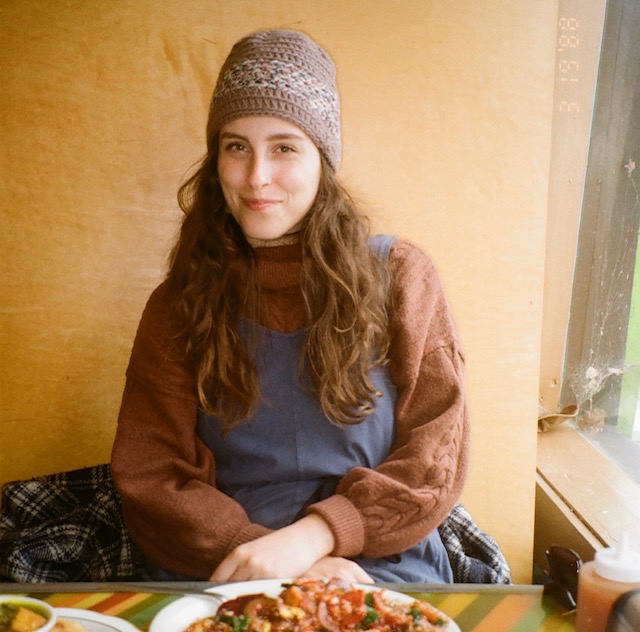
Lucia Frias-Wackman (she/her) graduated in May of 2022 with a major in Conservation Biology and certificates in Gender and Women’s Studies and Educational Science. Since graduation, Lucia has been up to a lot! In her first job post-undergrad, she worked alongside animal behavior ecology and feminist technology professors to look critically at the field of animal behavior science and understand how politics impact the field. This project is now published–“Feminism in the Wild: How Human Biases Shape Our Understanding of Animal Behavior”. That summer, in 2023, she hiked 600 miles in Spain on the Camino de Santiago–a dream she’d had for years. Following this, Lucia spent two years working in sexual violence prevention and is currently a sex educator at a community-based sexual and reproductive health clinic. Here, Lucia helps run and manage the Minnesota Sexual Health Hotline–a free, statewide service anyone can contact to get their sexual and reproductive health questions answered!
In her free time, you can find Lucia enjoying the Minneapolis lakes, trying a new restaurant (and writing about it), taking her orange tabby, Fern, for a walk and enjoying the vibrant art scene of the Twin Cities.
How does Gender and Women’s Studies/LGBTQ+ studies matter in the day-to-day of your professional life?
GWS gave me a deeper lens into the world with which I was presented. My studies helped me identify gaps, intersections, and barriers–the things that tend to lie below the surface and go overlooked, but are completely integral to understanding who someone is, and how you can best show up for them and care for them.
At the sexual health clinic where I work, we provide a plethora of services including STI (sexually transmitted infection) testing, hormone care and other gender-affirming care services. We also provide education–classes, one-to-one sessions and the sexual health hotline mentioned above. We are leaders in providing services to the LGBTQ+ community. When it comes to our bodies–and taking care of them, especially in a medical setting–it is crucial to remember what else is at play. Considering how history, politics (past and present) and access impact how folks come into our clinic, is key to being the compassionate, well-rounded providers and educators we strive to be. These are all skills I built in my GWS classes, and I apply them every day.
Do you have advice for students who may share your interests and may want to pursue a similar graduate degree and/or career?
I’ll break my advice down into three parts–trying everything, my portal into sexual health, and why you should take a GWS class (and other arts/humanities classes).
My advice, for school and life, is to do it all! I encourage you to try a little bit of everything–I was a restoration ecologist, STEM program coordinator, writer, researcher, server, bartender, canoe outfitter, volunteer program coordinator, and sexual violence prevention advocate ALL before I became a sex educator. I’m sure I’ll be many more things too. There is an incredible amount of value in trying something and realizing you don’t actually like it. This is also how you find what you do like. I graduated with a major in conservation biology and minors in gender and women’s studies and educational science–all over the place, but much more connected than you think. I now want to go to grad school for sexual health research (in London of all places! Wish me luck!). I apply my three fields in different ways every day. I’m so excited about the work I’ve done, the work I’m currently doing, and all that lies ahead. All that’s to say–things change. Run with it. Keep trying things.
As for working in sexual health education or the broader sex ed field–you will find passion. The thing about sexual health work is that a lot of people find it. By this, I mean that there is often a personal connection to the field, and that is what draws people in. The interest in the work is connected to the personal world, whether it be an experience you had (good or bad), a bothersome statistic, a tale from a friend, a fire to provide care in a way that you or a loved one didn’t receive and wished you had, or a desire to replicate a wonderful session with a provider or educator…There is a certain closeness–an intimacy–to the work that fuels it. It is a field that exists and changes because people ask questions, grow curious about things, and challenge the status quo. It is evolving towards the world that the people are asking for. It twists and turns towards knowledge gaps and begs for more questions to continue growing. It is not stopping. It is expanding. And this is thrilling. If you feel even an inkling of interest in the field, I suggest you explore it.
Lastly, take a GWS class, an art history class, a focused literature class–these are the things that make us human, that connect us, and that help us understand one another. These skills and teachings make us better providers, scientists, researchers…science is not separate from the scientist in the same way that art is not separate from the artist. We are touched by people, experiences and our worlds. This shows up in our work, even if we don’t realize it. Understanding this can only help you. Take a class or two, or run away with a minor.
What do you remember fondly from the Department of Gender & Women’s Studies? Favorite class? Instructor?
A few things immediately pop out at me–I remember my first GWS class–sophomore year, fall 2019, with Dr. Garlough. I remember the stars aligning in my head, and sitting so quietly in class because I had so many new things to think about and I was trying to process them all and I was so awestruck to know that I was in the right place. I knew that this was it. I’d never felt my brain turn on in such an intense way–it felt so alive. I think it took one or two lectures for me to decide that I wanted to minor in GWS. Hindsight, I would’ve majored.
I met Dr. Kate Phelps in GWS 423 (Gen&WS 423: The Female Body in the World: Body Politics in Cross Cultural Perspective) during the spring semester of 2021 when everything was still fully remote. I remember doing every reading in its entirety, and being so thrilled to log onto Zoom to share 75 minutes with the brilliant Dr. Kate and a class filled with 22 other little Zoom photo squares who were just as excited as me to be there. Dr. Kate created, over Zoom, what is incredibly difficult to create in person–a class filled with people who wanted to be nowhere else, and who were all itching to dig into the week’s work and who were excited to do it all together. To this day, I’ve never been more excited to log onto a Zoom as I was in spring 2021. I don’t see that changing.
Over the next year and a half, I got to know Dr. Kate better, taking GWS 444: From Past Feminisms to Postfeminism: Feminism for the 21st Century. This class was so heavy metal–the theories that we worked through were beautiful and intense and the final project of writing your own manifesto, goes down as my favorite assignment of all time. I remember connecting my work in GWS to the studies in my primate behavior ecology class and other conservation biology classes to create my take on the state of our planet. I was creating something truly interdisciplinary, and this set the stage for my work to come.
My eyes light up when I get one of Dr. Kate’s beautiful life update emails. I love seeing the letters UW and GWS in my inbox. I hope to be a part of this circle for a long, long time.
What, if anything, do you wish you could tell your undergraduate self?
You learn about you by following your interests and walking down the paths that they take you on. If you feel curious, intrigued or excited–follow that! You can have a life–and a career–that twists and turns according to what you find interesting. Listen to the voice that wants. Find out what is there. Follow it. Change and grow with it. That is (the voice of) your life–be with it.
Things have a funny way of working out. As some stranger told you in 2019 at Cheba Hut on a Thursday at 2 AM, “The joy is in the journey”. Boy, is it.