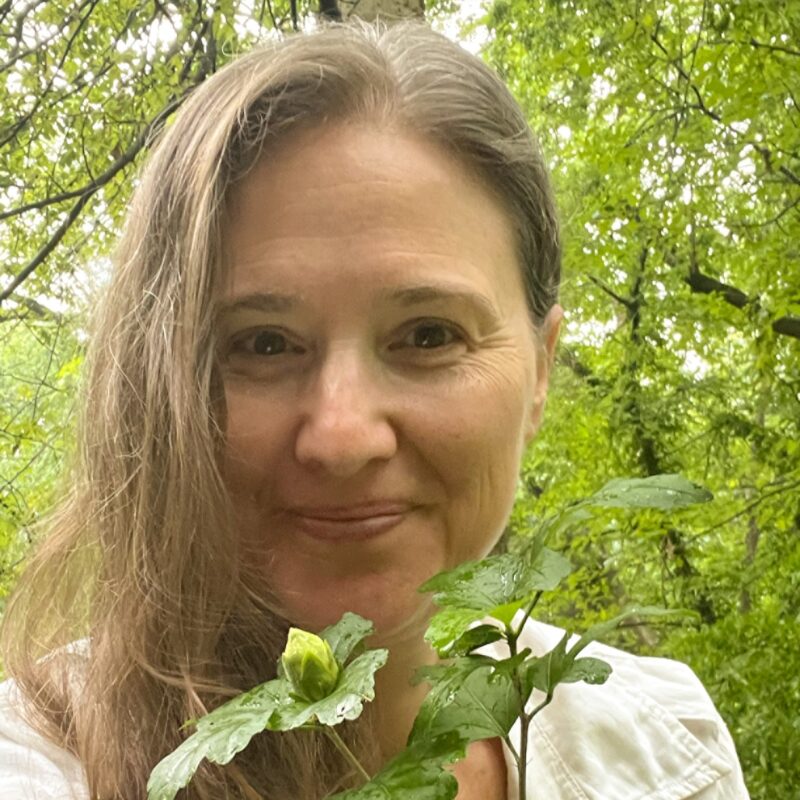
Ruth Goldstein
Assistant Professor of Gender & Women's Studies
she/her/hers
5197 Levy Hall
Biography
Ruth Goldstein, PhD is broadly interested in the gendered aspects of human and nonhuman health, a quickly heating planet and environmental racism. Her book: Life in Traffic: Women, Plants, and Gold Along South America’s Interoceanic Highway examines the socio-environmental consequences of transnational infrastructure projects and climate change along South America’s recently constructed longest latitudinal thoroughfare , with a particular focus on intersections of race and Indigeneity, cis and trans women’s health and “earth” rights in Brazil and Peru. Her subsequent research on mercury as a global pollutant analyzes the racialized weight of toxic body burdens and impacts on parent/child health.
Courses:
Gen&WS 104: Gender, Sexuality, and Global Health
Gen&WS 527: The Environment of the Womb: Epigenetics and Parent/Child Health
Gen&WS 533: Gender and Water: Fluidity, Ecology, and Justice
Gen&WS 103: Gender, Bodies, and Health
Gen&WS 103H: Gender, Bodies and Health, Honors Section
Gen&WS 533: Race, Gender, Botany
Gen&WS 539: Queering Ecofeminism and Environmental Racism
Gen&WS 950: Gender, Race, and Ecology
Select Publications:
2026. Life in Traffic: Woman, Plants, and Gold Along South America’s Interoceanic Highway, University of California Press, Public Anthropology Series, June 2026.
2023. Rubiano-Galvis, Sebastián, Jimena Diaz Leiva, and Ruth Goldstein. “Amalgamated Histories: Tracing Quicksilver’s Legacy Through Environmental and Political Bodies in Andean and Amazonian Gold Mining.” ambix 70(1): 54-76.
2022. “Life in Traffic: riddling fieldnotes on the political economy of ‘sex’ and nature.” Cultural Anthropology 37(2): 251-285. DOI: 10.14506/ca37.2.08 **Winner of the 2023 Cultural Horizon’s Prize**
2022. Pre-COP4.2 Side Event: Diálogo intercultural sobre Mercurio, Minería, Salud y Derechos colectivos, March 8, 2022.
2022. “Multispecies Traffic, Infrastructure and Empire in Latin America.” LASA Forum 53(2): 14-20.
2021. Ethnobotanies of Refusal: Methodologies in Respecting Plant(ed)-Human Resistance. Vol. 23, no. 3, ILHA – Revista de Antropologica.
2020. “Mercury’s Toxic Touch.” Anthropology News website, October 2, 2020. DOI: 10.14506/AN.1514
2020. “Ayahuasca and Arabidopsis: The Philosopher Plant and the Scientist’s Specimen.” Ethnos 86(2): 242-275.
2020. “Digamos Adiós al Mercurio”: Activos Tóxicos y Extracción Neocolonial.” Toxic News.
2020. “Making Mercury History: Toxic Assets and Neocolonial Extraction.” Toxic News.
2019. “Ethnobotanies of Refusal: Methodologies in Respecting Plant(ed)-Human Resistance.”Special Issue on Plant Ethnography, Anthropology Today 35(2): 18-22.
2018. “Consentimiento y Sus Discontentos: Género, Indigeneidad, y Extractivismo enMadre de Dios, Péru.” InGénero, sexualidades y mercados sexuales en sitios extractivistas de América Latina. Edited by Susanne Hofmann and Melisa Cabrapan Duarte. Mexico City: Centro de Investigaciones y Estudios de Género de la Universidad Nacional Autónoma de México (UNAM) Press, pp: 237-266.
2017. “Collaborations: Envisioning an Engaged Future for Anthropology” with Patricia Alvarez and Ugo Edu. History of Anthropology Newsletter.
2015. “Semiophors and Sexual Systems: The Circulation of Words and Women.” Pragmatics and Society 6(2): 217-239.
2014. “Consent and Its Discontents: On the Traffic in Words and Women.” Latin American Policy 5(2): 236-250.
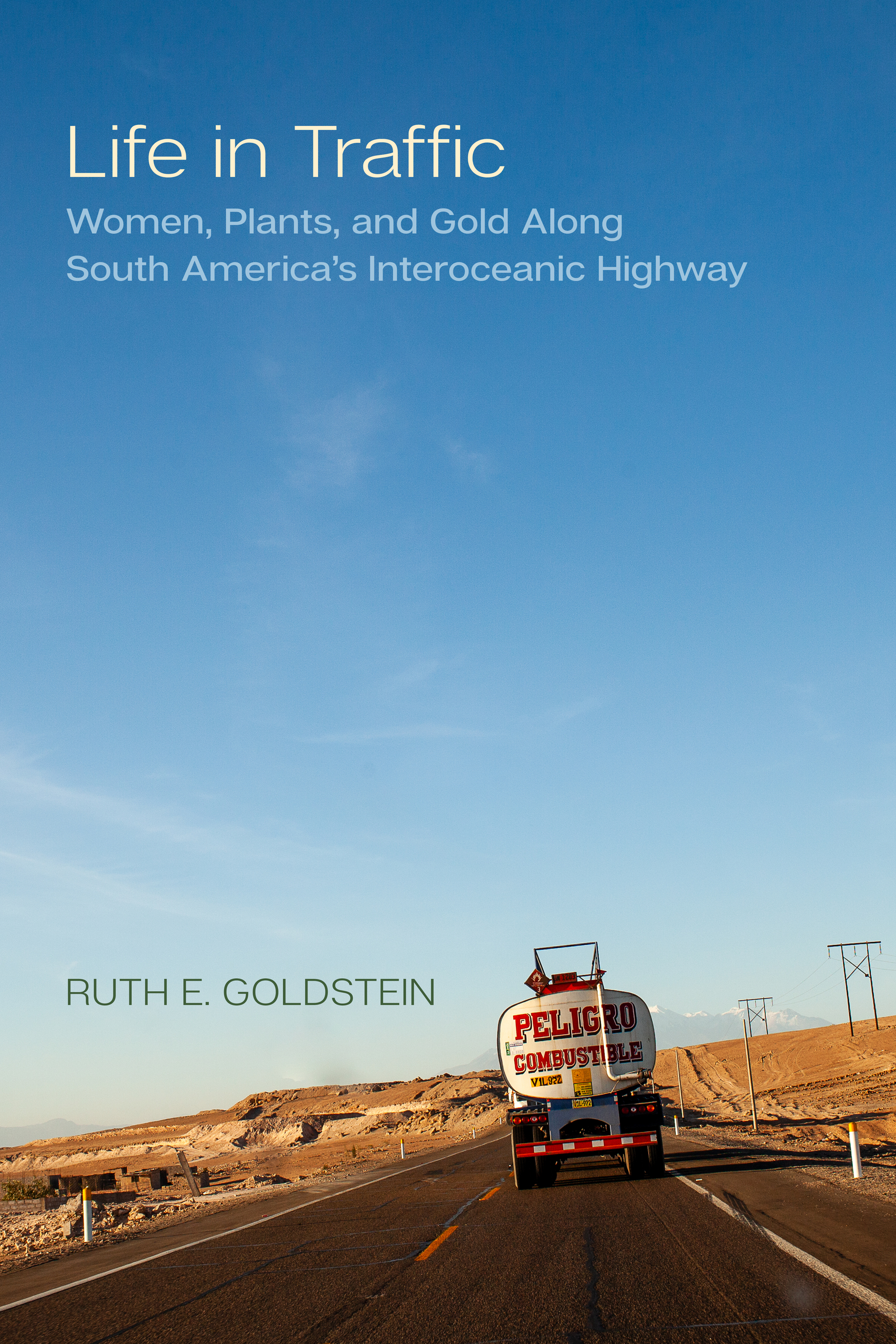
Life in Traffic: Women, Plants, and Gold Along South America’s Interoceanic Highway
Goldstein, R. Life in Traffic: Women, Plants, and Gold Along South America’s Interoceanic Highway. University of California Press, 2026.
In the year 2000, the presidents of Brazil, Peru, and Bolivia agreed to construct the Interoceanic Highway as part of the Initiative for the Integration of the Regional Infrastructure of South America. Instead of bringing the promised economic benefits to the shared triple-frontier Amazonian region, the highway facilitated trade in extracted natural resources as well as a traffic in women. Centering “traffic” as both an analytic and a method, Ruth E. Goldstein argues that projects like this 3,500-mile highway have deeply gendered effects, reorganizing political economies of sex, nature, kinship, and care. Life in Traffic underscores how markets for women, plants, and gold are not just intersecting phenomena but historically co-constituted economies. Amazonian extractive industries, too, have global ramifications for a warming planet: as rainforests disappear, so do the oxygen-creating, carbon-sequestering, and life-sustaining abilities of Mother Earth.
For more information on Life in Traffic, click here.