Reflections on Dr. Brittney Cooper’s Keynote Address from Ph.D. Student, fatou janneh
“We are the storm…We are the light and the lightning and the boom back and the thundercloud. We are the storm”— Dr. Brittney Cooper
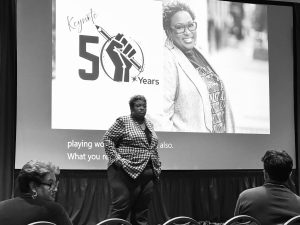 In delivering Saturday’s keynote address on the 50th anniversary of the Department of Gender and Women’s Studies, Dr. Brittney Cooper gave a powerful speech. After being introduced by Professor Nicholas Syrett, chair of GWS, Dr. Cooper addressed a diverse audience of professors, students, and activists from UW–Madison. In her talk, Cooper used the metaphor of the storm to explore resilience, Black feminist praxis, and the power of collective action in the face of structural oppression. She traces the historical context of GWS back to radical feminist movements in the 1960s
and 70s. As she recalls, the GWS program was created when radical projects, which had been violently suppressed by the government, ran for “safe haven into the university.” She asserts that the core challenge for universities today is whether they will defend these very programs, using their “considerable institutional resources to stand up against the storm of attacks” on sites of “internal dissent against the central features that the university isn’t invested in building.” Like Audre Lorde’s The Master’s Tools, Cooper reminds her audience how institutions reproduce the very hierarchies they critique.
Drawing on childhood lessons from Louisiana thunderstorms, Dr. Cooper recalls the fearsome summer tempests that defined her environment. She notes that “when a thunderstorm came, my grandmother would say… turn off the lights, plug all the electric spark somewhere safe. My cousin always thought this was a pain in the neck.” This early experience of respect for nature and attentiveness to power foreshadows her larger argument about navigating social and institutional forces. The act of “unplugging” she says becomes a metaphor for survival in a world that is often unprepared for the energy, ideas, and demands of Black women and activists. As Dr. Cooper explains, it is not only literal power that must be managed but also the metaphorical power of challenging systems. According to her “our national infrastructure was not set up to handle the unrelenting movements demanding justice… white supremacy and patriarchy.” Through this story, she shows how careful observation, adaptability and respect for unseen forces can equip individuals to thrive in challenging environments, skills that translate directly into social activism and education. Similar to her work in Eloquent Rage, she shares similar arguments of redefining anger and intensity as a source of empowerment. She frames rage as a force that is capable of dismantling oppressive systems and fueling collective liberation.
In delivering Saturday’s keynote address on the 50th anniversary of the Department of Gender and Women’s Studies, Dr. Brittney Cooper gave a powerful speech. After being introduced by Professor Nicholas Syrett, chair of GWS, Dr. Cooper addressed a diverse audience of professors, students, and activists from UW–Madison. In her talk, Cooper used the metaphor of the storm to explore resilience, Black feminist praxis, and the power of collective action in the face of structural oppression. She traces the historical context of GWS back to radical feminist movements in the 1960s
and 70s. As she recalls, the GWS program was created when radical projects, which had been violently suppressed by the government, ran for “safe haven into the university.” She asserts that the core challenge for universities today is whether they will defend these very programs, using their “considerable institutional resources to stand up against the storm of attacks” on sites of “internal dissent against the central features that the university isn’t invested in building.” Like Audre Lorde’s The Master’s Tools, Cooper reminds her audience how institutions reproduce the very hierarchies they critique.
Drawing on childhood lessons from Louisiana thunderstorms, Dr. Cooper recalls the fearsome summer tempests that defined her environment. She notes that “when a thunderstorm came, my grandmother would say… turn off the lights, plug all the electric spark somewhere safe. My cousin always thought this was a pain in the neck.” This early experience of respect for nature and attentiveness to power foreshadows her larger argument about navigating social and institutional forces. The act of “unplugging” she says becomes a metaphor for survival in a world that is often unprepared for the energy, ideas, and demands of Black women and activists. As Dr. Cooper explains, it is not only literal power that must be managed but also the metaphorical power of challenging systems. According to her “our national infrastructure was not set up to handle the unrelenting movements demanding justice… white supremacy and patriarchy.” Through this story, she shows how careful observation, adaptability and respect for unseen forces can equip individuals to thrive in challenging environments, skills that translate directly into social activism and education. Similar to her work in Eloquent Rage, she shares similar arguments of redefining anger and intensity as a source of empowerment. She frames rage as a force that is capable of dismantling oppressive systems and fueling collective liberation.
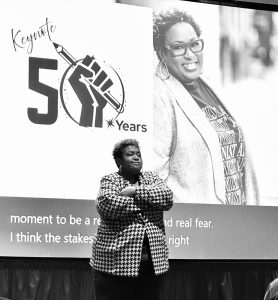 In Dr. Cooper’s keynote, the storm is not only a force from the outside, forcing our adaptation. It is also a metaphor for the energy we can channel to change systems of injustice and inequalities. She repeatedly emphasizes that, “every time we say a thing that their infrastructure cannot handle, we are the power surge… We are the storm.” Here, the storm represents disruption of systems that are unprepared to respond to demands for equity, inclusion, and justice. Her speech compels the audience to see themselves as active participants in transformation. Their voices, actions, and ideas represent real change, even when institutions seem immovable.
Dr. Cooper also critiques universities and neoliberal pressures, refusing to shy away from critiquing the institutions that house feminist and social justice work. She discusses the pressures placed on universities to prioritize STEM and business education over the humanities, social sciences and critical thinking. According to her, “the university… often acts as a tool of empire and elitism. Still, it has been a safe haven for radicals.” While critiquing the co-optation of frameworks like diversity, equity and inclusion (DEI), she states that “intersectionality… becomes easily corruptible when reduced to personal identity workshops instead of addressing systems of white supremacy, patriarchy and capitalism.” She also highlights how institutions can simultaneously enable and constrain transformative work. Dr. Cooper challenges us to recognize the gaps between rhetoric and action. Her insistence on confronting these contradictions reiterates Patricia Hill Collin’s argument. Collins argues that Black feminist thought is not a mere theory but a lived, collective project that resists domination and reimagines power. Similarly, she shows that most radical work happens when theories are translated into lived experience. In this sense, situates feminist praxis as central to institutional and social change.
At the heart of her speech is the enduring influence of Black feminist thought. She credits her education and mentors for shaping her understanding. She emphasizes that “Black feminism is a world-making project” helping us to “imagine what the world could be.” Black feminist praxis, as she describes it, is both analytical and imaginative. It provides the language and frameworks to understand oppression while also opening the possibility for new, just, and inclusive worlds. She emphasizes that this is not theoretical abstraction. It is active, embodied, and collective work.
Dr. Cooper concludes her speech by urging her audience to resist harmful forms of power and to cultivate alternative energies. According to her, “We too can unplug from the wrong kinds of power… from investment in capitalism, in neoliberalism, in endless self-optimization.” She reminds her audience that survival, creativity, and justice require intentional disengagement from forces that seek to exploit, dominate, or dehumanize:
“We are world-makers and space-takers and truth-tellers…We know what it looks like to survive in the dark. We are people who know what it means to dance through rain. We can unplug from the forms of power that would…kill us.”
Dr. Cooper’s keynote affirms that Black feminist thought remains a vital living force. Her metaphor reminds us that storms demand resistance and resilience, and, moreover, that the lightning cannot last forever.
In Dr. Cooper’s keynote, the storm is not only a force from the outside, forcing our adaptation. It is also a metaphor for the energy we can channel to change systems of injustice and inequalities. She repeatedly emphasizes that, “every time we say a thing that their infrastructure cannot handle, we are the power surge… We are the storm.” Here, the storm represents disruption of systems that are unprepared to respond to demands for equity, inclusion, and justice. Her speech compels the audience to see themselves as active participants in transformation. Their voices, actions, and ideas represent real change, even when institutions seem immovable.
Dr. Cooper also critiques universities and neoliberal pressures, refusing to shy away from critiquing the institutions that house feminist and social justice work. She discusses the pressures placed on universities to prioritize STEM and business education over the humanities, social sciences and critical thinking. According to her, “the university… often acts as a tool of empire and elitism. Still, it has been a safe haven for radicals.” While critiquing the co-optation of frameworks like diversity, equity and inclusion (DEI), she states that “intersectionality… becomes easily corruptible when reduced to personal identity workshops instead of addressing systems of white supremacy, patriarchy and capitalism.” She also highlights how institutions can simultaneously enable and constrain transformative work. Dr. Cooper challenges us to recognize the gaps between rhetoric and action. Her insistence on confronting these contradictions reiterates Patricia Hill Collin’s argument. Collins argues that Black feminist thought is not a mere theory but a lived, collective project that resists domination and reimagines power. Similarly, she shows that most radical work happens when theories are translated into lived experience. In this sense, situates feminist praxis as central to institutional and social change.
At the heart of her speech is the enduring influence of Black feminist thought. She credits her education and mentors for shaping her understanding. She emphasizes that “Black feminism is a world-making project” helping us to “imagine what the world could be.” Black feminist praxis, as she describes it, is both analytical and imaginative. It provides the language and frameworks to understand oppression while also opening the possibility for new, just, and inclusive worlds. She emphasizes that this is not theoretical abstraction. It is active, embodied, and collective work.
Dr. Cooper concludes her speech by urging her audience to resist harmful forms of power and to cultivate alternative energies. According to her, “We too can unplug from the wrong kinds of power… from investment in capitalism, in neoliberalism, in endless self-optimization.” She reminds her audience that survival, creativity, and justice require intentional disengagement from forces that seek to exploit, dominate, or dehumanize:
“We are world-makers and space-takers and truth-tellers…We know what it looks like to survive in the dark. We are people who know what it means to dance through rain. We can unplug from the forms of power that would…kill us.”
Dr. Cooper’s keynote affirms that Black feminist thought remains a vital living force. Her metaphor reminds us that storms demand resistance and resilience, and, moreover, that the lightning cannot last forever.
Dr. Brittany Cooper speaking at the GWS 50th Anniversary celebration.
In Dr. Cooper’s keynote, the storm is not only a force from the outside, forcing our adaptation. It is also a metaphor for the energy we can channel to change systems of injustice and inequalities. She repeatedly emphasizes that, “every time we say a thing that their infrastructure cannot handle, we are the power surge… We are the storm.” Here, the storm represents disruption of systems that are unprepared to respond to demands for equity, inclusion, and justice. Her speech compels the audience to see themselves as active participants in transformation. Their voices, actions, and ideas represent real change, even when institutions seem immovable.
Dr. Cooper also critiques universities and neoliberal pressures, refusing to shy away from critiquing the institutions that house feminist and social justice work. She discusses the pressures placed on universities to prioritize STEM and business education over the humanities, social sciences and critical thinking. According to her, “the university… often acts as a tool of empire and elitism. Still, it has been a safe haven for radicals.” While critiquing the co-optation of frameworks like diversity, equity and inclusion (DEI), she states that “intersectionality… becomes easily corruptible when reduced to personal identity workshops instead of addressing systems of white supremacy, patriarchy and capitalism.” She also highlights how institutions can simultaneously enable and constrain transformative work. Dr. Cooper challenges us to recognize the gaps between rhetoric and action. Her insistence on confronting these contradictions reiterates Patricia Hill Collin’s argument. Collins argues that Black feminist thought is not a mere theory but a lived, collective project that resists domination and reimagines power. Similarly, she shows that most radical work happens when theories are translated into lived experience. In this sense, situates feminist praxis as central to institutional and social change.
At the heart of her speech is the enduring influence of Black feminist thought. She credits her education and mentors for shaping her understanding. She emphasizes that “Black feminism is a world-making project” helping us to “imagine what the world could be.” Black feminist praxis, as she describes it, is both analytical and imaginative. It provides the language and frameworks to understand oppression while also opening the possibility for new, just, and inclusive worlds. She emphasizes that this is not theoretical abstraction. It is active, embodied, and collective work.
Dr. Cooper concludes her speech by urging her audience to resist harmful forms of power and to cultivate alternative energies. According to her, “We too can unplug from the wrong kinds of power… from investment in capitalism, in neoliberalism, in endless self-optimization.” She reminds her audience that survival, creativity, and justice require intentional disengagement from forces that seek to exploit, dominate, or dehumanize:
“We are world-makers and space-takers and truth-tellers…We know what it looks like to survive in the dark. We are people who know what it means to dance through rain. We can unplug from the forms of power that would…kill us.”
Dr. Cooper’s keynote affirms that Black feminist thought remains a vital living force. Her metaphor reminds us that storms demand resistance and resilience, and, moreover, that the lightning cannot last forever.