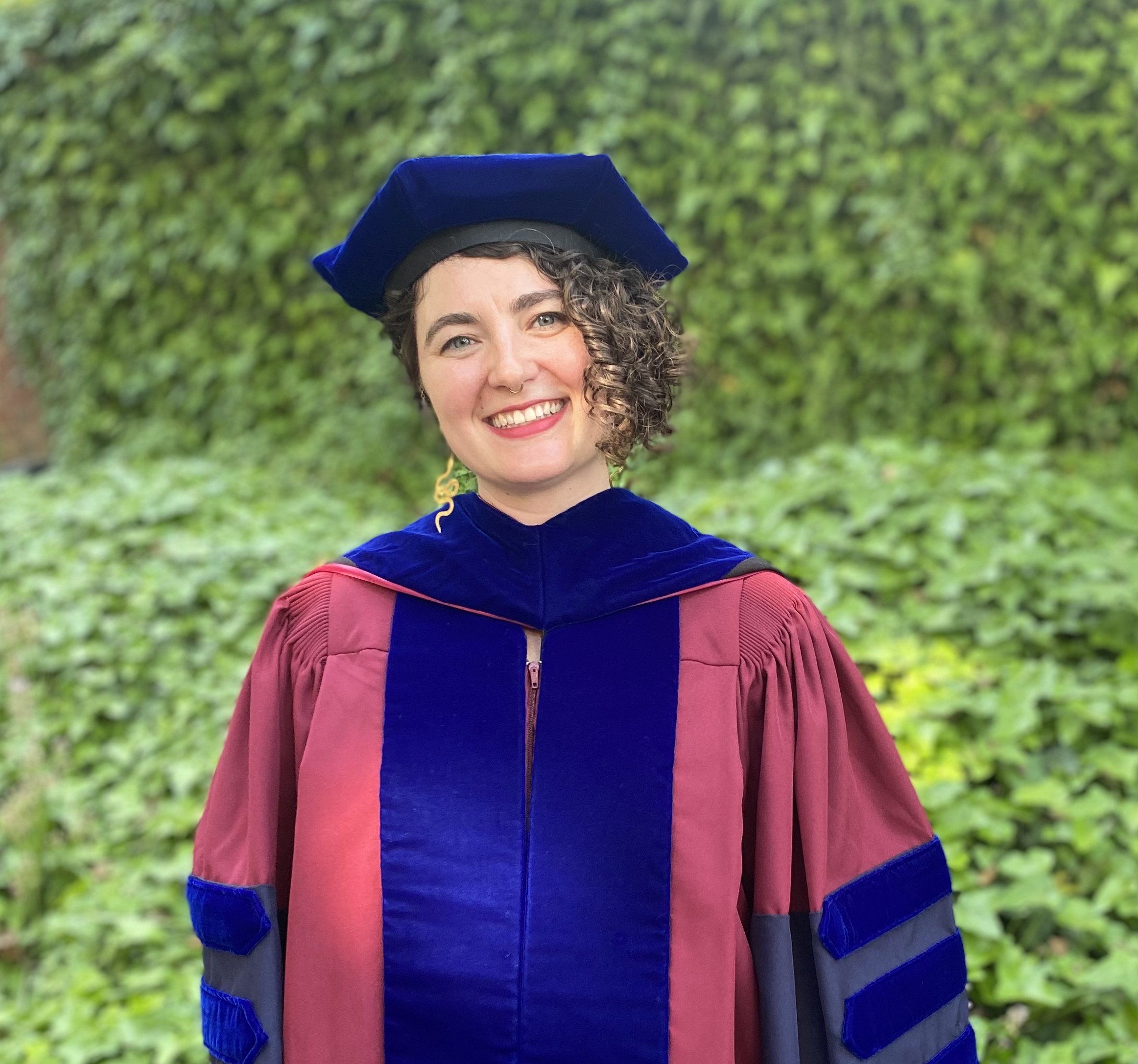
Alexandra Kralick
Wittig Postdoctoral Research Fellow in Feminist Biology
she/her
5185 Levy Hall
Biography
Dr. Alexandra Kralick is the Wittig Postdoctoral Research Fellow in Feminist Biology at the University of Wisconsin–Madison. She received her PhD in Anthropology in 2023 from the University of Pennsylvania and held a postdoctoral research fellowship at Harvard University in feminist science studies. Bringing these trainings together, she interweaves feminist epistemologies and evolutionary biology to examine within-sex variation in our closest living relatives, the great apes.
Her research centers on orangutans, where she investigates a dramatic and understudied form of within-male variation whereby some males develop large cheek pads, or flanges, while others delay flanging for several years or even their entire lives. She developed a method for identifying each type of male in museum collections, and her work has illuminated variation in their skeleton, including body size, stress correlates, and more. Currently, she is building a project that connects skeletal morphology to behavior in the wild to disentangle traits typically only associated with one sex. Looking ahead, she is expanding her primatological research to illuminate within-sex variation across primate taxa.
Publications
Kralick, A. E., Zemel, B., Lin, P., Nolan, C., & Tocheri, M. W. (2024). Relative leg-to-arm skeletal strength proportions in orangutans by species and sex. Journal of Human Evolution, 188, 103496. https://doi.org/10.1016/j.jhevol.2024.103496
Kralick, A. E., O’Connell, C. A., Bastian, M. L., Hoke, M. K., Zemel, B. S., Schurr, T. G., & Tocheri, M. W. (2023). Beyond dimorphism: Body size variation among adult orangutans is not dichotomous by sex. Integrative and Comparative Biology, 63(4), 907–921. https://doi.org/10.1093/icb/icad015
Kralick, A. E., Canington, S., Eller, A., & McGrath, K. (2023). Specimens as individuals: Four interventions and recommendations for great ape skeletal collections research and curation. Evolutionary Anthropology, 1, 20. https://doi.org/10.1002/evan.22002
Sharpe, S., Anderson, A. P., Cooper, I., Kralick, A. E., James, T., Lindahl, H., Lipshutz, S., McLaughlin, J. F., Subramaniam, B., Weigel, A. R., & Lewis, A. K. (2023). Sex and biology: Broader impacts beyond the binary. Integrative and Comparative Biology, 1,8. https://doi.org/10.1093/icb/icad113
Kralick, A. E., & McGrath, K. (2021). More severe stress markers in the teeth of flanged versus unflanged orangutans (Pongo spp.). American Journal of Physical Anthropology, 176(4), 625–637. https://doi.org/10.1002/ajpa.24387
Kralick, A. E., & Zemel, B. S. (2020). Evolutionary perspectives on the developing skeleton and implications for lifelong health. Frontiers in Endocrinology, 11,99. https://doi.org/10.3389/fendo.2020.00099
McGrath, K., Reid, D., Guatelli-Steinberg, D., Arbenz-Smith, K., El Zaatari, S., Fatica, L. M., Kralick, A. E., Cranfield, M. R., Stoinski, T. S., Bromage, T., Mudakikwa, A., & McFarlin, S. C. (2019). Faster growth corresponds with shallower linear hypoplastic defects in great ape canines. Journal of Human Evolution, 137, 102691.
Kralick, A. E., Burgess, M. L., Golwacka, H., Arbenz-Smith, K., McGrath, K., Ruff, C. B., Chan, K., Cranfield, M. R., Stoinski, T. S., Bromage, T. G., Mudakikwa, A., & McFarlin, S. C. (2017). A radiographic study of permanent molar development in wild Virunga mountain gorillas of known chronological age from Rwanda. American Journal of Physical Anthropology, 163(1), 129–147.