Faculty Focus: Alexandra Kralick
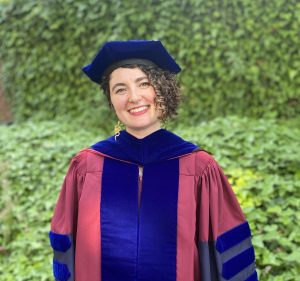 The Department of Gender & Women’s Studies is so pleased to have Dr. Alexandra Kralick joining us as a Wittig Postdoctoral Research Fellow in Feminist Biology! To help you get to know her, we asked her some questions. Please read below to learn about Dr. Kralick!
Name:
The Department of Gender & Women’s Studies is so pleased to have Dr. Alexandra Kralick joining us as a Wittig Postdoctoral Research Fellow in Feminist Biology! To help you get to know her, we asked her some questions. Please read below to learn about Dr. Kralick!
Name:
Alexandra E. Kralick, Ph.D.
Title:Wittig Postdoctoral Research Fellow in Feminist Biology
Hometown:Washington, DC area
Educational/professional background:I earned my B.S. in Biological Anthropology from George Washington University and my Ph.D. in Anthropology from the University of Pennsylvania. I subsequently held a postdoctoral fellowship in Harvard University’s Studies of Women, Gender, and Sexuality and later served as a Visiting Assistant Professor at Bryn Mawr College before joining the department here at UW–Madison!
What is your field of research, and how did you get into it?While I consider my field of research to be biological anthropology and primatology, I come at it from an intersectional lens. I study within-sex variation in non-human primate anatomy and behavior as well how science comes to understand sex-linked variation in primates from a critical science studies lens.
From a young age reading Scientific American magazines and watching human evolution documentaries on the History Channel, I was always deeply curious about the lives of our non-human primate relatives and the implications of sex differences on biology. I had known from the moment I stepped foot onto a college campus as an undergraduate that the first class I would sign up would be an introductory biological anthropology course. I asked the professor who taught that course if I could get involved in research with her and set out to study gorilla life history and dental development with her. I was lucky enough to travel with her to Rwanda at the age of 19 and excavate the skeletons of mountain gorillas who had died at the Karisoke Research Center, and that point on, I was hooked.
In my Ph.D. program, I found myself finally directly studying sex differences in human evolution, but in a four-field anthropology department that continually prompted me to grapple with the problematic histories of my discipline and to think critically and deeply about sex essentialism in the ways we study biological sex. This environment totally changed the way I wanted to engage with this work and led me to pursue training in feminist science studies through a postdoc at Harvard.
Across these various trainings, I found my way to a niche in feminist primatology. Today, my research bridges field observation, skeletal analysis, and feminist critique to illuminate the complexity of great ape lives and to reflect deeply on the evolutionary stories we tell about our closest living relatives, and ourselves.
What attracted you to UW–Madison?Ever since virtually attending the Feminist Biology Symposium in 2021, organized by former Wittig Postdoc Dr. Kelsey Lewis-Pilcher, I had hoped to apply to the Wittig Fellowship. When my availability finally aligned with the application cycle, I was eager to join such caring and dynamic community invested in interdisciplinary feminist science.
What was your first visit to campus like?In summer 2025, I flew to Madison, WI to apartment-hunt and I met with Chris and Tracy for coffee at the CRGW. They both walked me around campus, showing me their favorite spots on a warm, gorgeous day. I was struck by how picturesque the campus was and by how kind and welcoming everyone was to me. Chris even offered an umbrella in case it rained. I continue to be blown away every day by the warmth of this community.
Favorite place on campus?I’m still acquainting myself with campus, but nothing has topped the live music, local beer, and vegan brats on a Saturday evening in the summer at the Memorial Union Terrace.
Do you feel your work relates in any way to the Wisconsin Idea?I’m an avid mentor, and at UW–Madison I am excited to involve students directly in my research. When I begin working with a mentee, we co-create goals and design opportunities tailored to their interests, whether that involves conference networking, skills development, or research training. I’m also committed to building broader mentorship structures across the discipline. In my role as Co-Chair of the AABA Biological Anthropologists Women’s Mentoring Network (BAWMN), I’m helping organize events rooted in collective support, including an upcoming World Café on collective action.
Hobbies/other interests:I recharge through movement: kickboxing, rock climbing, hiking, and biking around Madison. I also love diving into an immersive speculative fiction novel with my book club.